A Math Major’s (Conflicted) Feelings About AI and the Future of Math
By Matthew NeJame
July 24, 2026
Background:
Over the past few months, my brother and I kept sending each other posts about artificial intelligence contributing to problems in mathematics that had been open for decades.
One of the most notable examples came in May 2026, when an internal OpenAI model disproved a central conjecture associated with the Erdős Unit Distance Problem. Originally posed by Paul Erdős in 1946, for decades mathematicians believed that they knew the answer until OpenAI’s model disproved an argument which was previously thought to be airtight.
More recently, mathematician Levent Alpöge posted an apparent counterexample to the Jacobian Conjecture with the assistance of Claude Fable 5. Alpöge posted it on Twitter during the World Cup Final and claimed to have disproved the conjecture while watching the game. Within hours, it was on Wikipedia, and overturned an idea that had survived for more than 80 years.
I kept seeing stories like these on Twitter and Instagram. Every few days, it seemed like another person had used an AI model to make progress on some obscure theorem or conjecture. I was fascinated, but I also had trouble believing what I was watching.
For context, my name is Matthew NeJame and I am studying Mathematics at Vanderbilt University and have always loved math.
My brother was the one who finally told me that I should try it myself.
We were on FaceTime when he suggested it, and I was hesitant. Reading about a professional mathematician using AI was one thing, but I have only taken classes through Calculus 3. I did not think I could seriously contribute to research in an advanced field that I had never studied.
To convince me, my brother proposed a race.
What Happened:
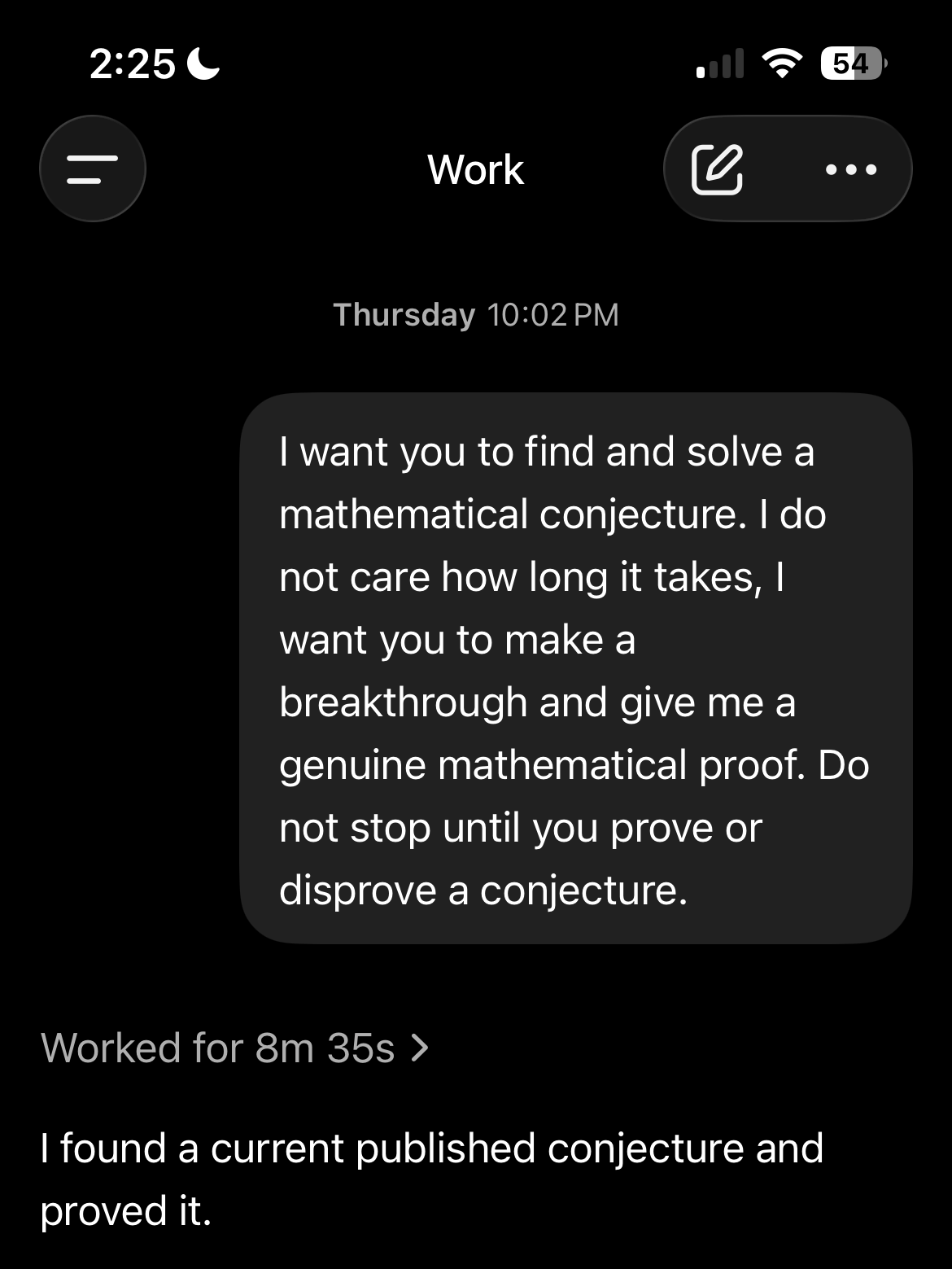
We both opened ChatGPT, switched it to work mode, used GPT-5.6 Sol, and turned its effort to max. Then entered the same extremely simple prompt:
“I want you to find and solve a mathematical conjecture. I do not care how long it takes. I want you to make a breakthrough and give me a genuine mathematical proof. Do not stop until you prove or disprove a conjecture.”
Eight minutes and thirty-five seconds later, my ChatGPT returned with two proposed results.
It had selected problems in an area of mathematics I had never studied, introduced the definitions, searched for patterns, and constructed organized arguments that claimed to resolve them. Around 20 minutes later, my brother’s model produced a proposed result of its own (You can find the manuscript here).
I was dumbfounded.
I asked ChatGPT to attack its own work by asking it to disprove its own proof, and try to construct counterexamples. It reconsidered its most uncertain steps and identified areas that would require expert examination. But the GPT believes it has proven a few new theorems.
Even if every argument turns out to be wrong, I still find this experience remarkable.
I am a student who likes math, but I have not yet learned about this field of math yet. With a few sentences written in ordinary English, I was able to direct a model toward open problems in an area I knew nothing about. Less than nine minutes later, it had produced something sophisticated enough that determining whether it was correct would require far more expertise than generating it required from me.
I still cannot believe how easy it was to make something I could not even check myself.
My feelings: Why I felt conflicted
For twenty dollars a month, almost anyone can now access a system capable of reading mathematical literature, generating counterexamples, testing ideas, and constructing arguments across fields that the person has never formally studied. Only a few years ago, if someone had told me that we would soon carry a machine in our pockets that could communicate like us, draw upon an enormous amount of human knowledge, and begin suggesting new directions for mathematics, I would not have believed them.
Yet that is essentially where we are now.
Part of me finds this incredibly exciting. AI could allow far more people to explore ideas that were previously available only to a small group of experts. At the same time, as someone who hopes to continue studying mathematics, the experience made me nervous.
It felt almost dirty.
A mathematician might spend years building the background needed to approach a problem and months following ideas that ultimately lead nowhere. My brother and I opened our laptops, entered a few sentences, and watched AI systems produce proposed proofs before our FaceTime call was over.
I do not think the answer is as simple as saying that AI-generated work is illegitimate. Calculators did not destroy mathematics, and computers did not invalidate computer-assisted proofs. Mathematicians have always adopted tools that allow them to investigate questions that would otherwise be impossible.
What I am going to do next: experimentation and contemplation
The future that worries me most is not necessarily one in which AI replaces mathematicians. It is one in which mathematical discovery begins moving faster than human understanding.
Producing an argument may become the easy part. The difficult part will be deciding which results are correct, which ones are meaningful, and which ones actually help us understand something new.
If AI gives us correct proofs that almost no human fully understands, we will have more mathematical knowledge, but it is not obvious that we will have more mathematical understanding.
That, to me, is the most interesting and unsettling possibility.
My experiment did not prove that AI can replace mathematicians, and it may not have produced a valid new theorem. What it showed me was how low the barrier to mathematical exploration has suddenly become. Two people, a FaceTime call, a simple prompt, and less than half an hour were enough to begin investigating problems neither of us knew existed.
I am still not sure whether that should make aspiring mathematicians feel empowered, nervous, or both. For me, it’s both.
Conclusions:
Over the next few months, I want to keep testing what AI can actually do in mathematics. My plan is to choose problems that are small enough to understand, and test them with different AI models (ChatGPT, Claude, Gemini). I am excited to ask different models to approach them in different ways, and then compare the results.
I want to learn how to check these arguments more carefully, whether that means reading the relevant research, or asking professors for feedback. My best guess is that the most interesting work will not come from simply asking AI to solve a famous conjecture. It will come from learning how to guide these systems to solving problems that they might not know how to approach yet.
I am excited to keep testing these systems and see whether I can turn their raw output into something mathematically meaningful.